The great bifurcation
Venture capital is unrecognizable from what it was a decade ago. Two seemingly unrelated innovations obliterated the old regime: Y Combinator's SAFE note in 2013 and SoftBank's Vision Fund in 2017. While the SAFE democratized raising venture capital, making it easier for founders to get funding earlier than ever SoftBank made it so costly to compete at scale that only infinite capital could win.
Everyone got squeezed in the middle of these two invisible macro forces with legacy investors pushed to raise bigger vehicles chasing fewer opportunities.. driving prices to insanity, and most importantly creating a vacuum at the earlier stage where a new wave of managers is writing a new chapter in the history of the asset class.
YC claim to fame
Before 2013, raising your first round was prohibitively expensive. Founders would spend upwards of $50k in legal fees driven by lengthy negotiations over liquidation preferences, board seats, veto rights, and all the trimmings that come with proper governance. Months of runway burnt on paperwork for a company that might not even exist in a few weeks.
Convertible notes existed but came with ways for investors to take control when things went sideways. Worse, they were ontologically wrong. Debt instruments in an equity game? As Carolynn Levy, the SAFE's creator, put it: "Do you want to start your relationship off with your investor arguing whether interest should be 3% or 10%? That is just not good for the ecosystem."
Then in the winter of 2013, YC dropped the SAFE. Five pages. No security. No governance rights. No board seats. No interest rates. No maturity dates. Just "give us money now, we'll figure out what it's worth later."
The SAFE went instantly viral. Anyone could download it from YC's website and use it to raise capital at no cost. It became the standard for seed rounds, making early-stage capital an undifferentiated commodity where speed is the only thing that matters.
Masa's Nuclear Submarine
Four years later, SoftBank launched a $100 billion venture fund. Putting this in perspective: global VC deployment that year was $200 billion. U.S. deployment was $84 billion. Masa rolled up enough capital to match the entire American venture industry and then some.
This wasn't just bigger checks, but an existential threat for storied venture firms such as Kleiner, Sequoia, Benchmark, and the likes. Every multi-stage fund suddenly faced the same faith: scale up or get priced out. When your competitor can write $100 million checks without blinking an eye, your $10 million lead commitment just won't get attention of the most ambitious founders.
The industry response was swift. Driven in part by the run-up of adoption across SaaS, Fintech and Cloud, fund sizes exploded as everyone raised bigger vehicles to compete for the same later stage deals. Unit economics became optional. Profitability became something you worried about "eventually." The entire startup playbook shifted from "get to liquidity asap" to "as long as you grow fast(est), Masa will fund you."
SoftBank didn't just inflate valuations, they proved private markets could provide infinite capital.
The great bifurcation
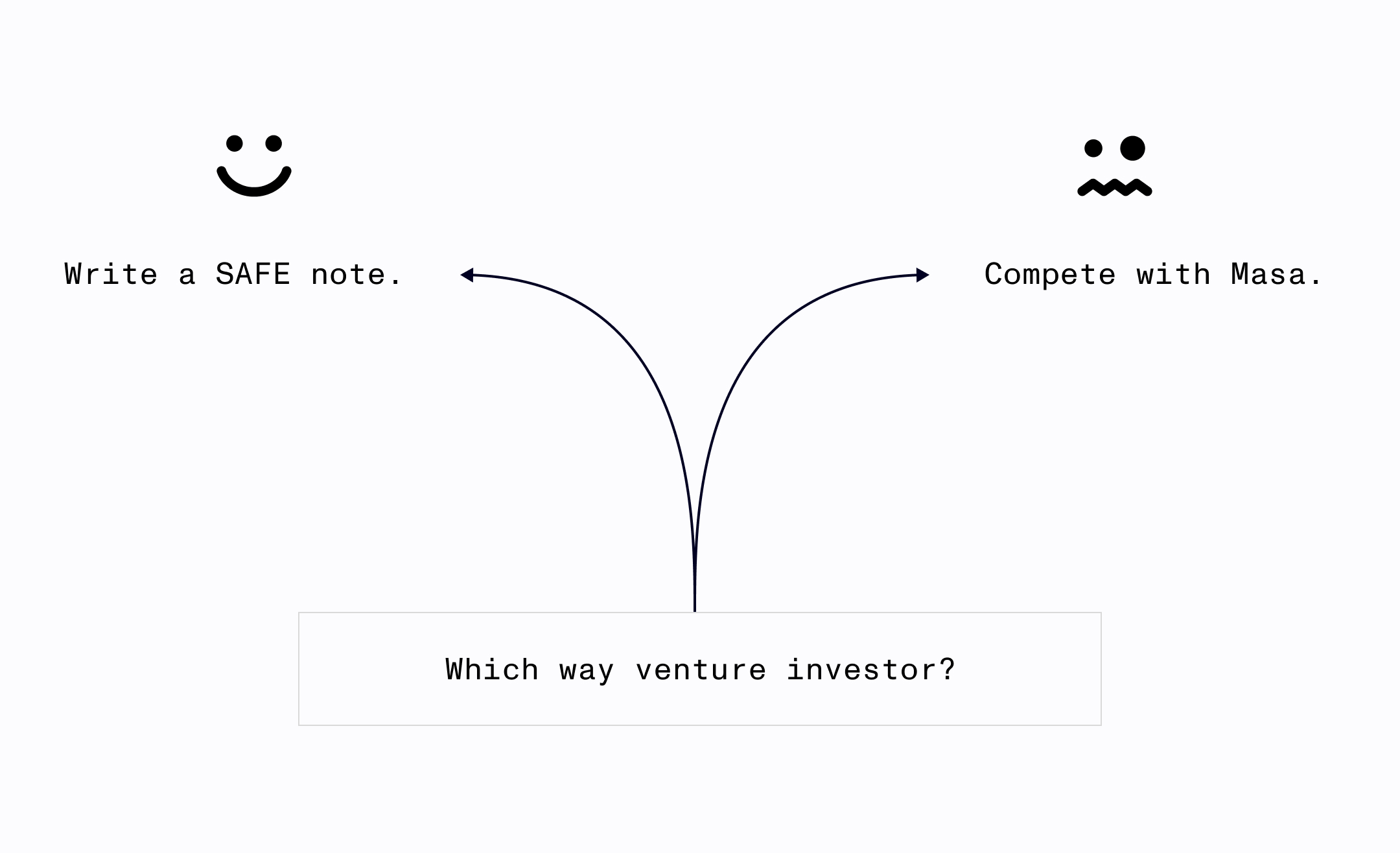
These two innovations created the venture landscape we're in today. Investors had to choose a path: go micro (capitalizing on the SAFE note) or go mega (competing at Vision Fund scale).
Multi-billion dollar funds can't return on single-digit billion exits that aren't coming anyway so they stopped showing up early. They wait for breakout signals, write bigger checks into safer bets, and manufacture returns through concentration.
Early stage got commoditized. Every seed fund writes similar checks on the same terms at similar valuations. Differentiation is access, speed, and what happens after the wire. The entire middle collapsed. The old guard can't play small, their economics don't work. Traditional seed funds can't compete with platforms that have infinite capital and zero price sensitivity. What's left is a barbell: mega-funds writing $50M+ checks into growth, and a fragmented network of angels and emerging managers writing true first checks.
That's not a gap. That's the opportunity. The alpha didn't disappear, it migrated. To companies raising $500K on a SAFE before anyone's heard of them. To founders building in stealth for 18 months before they need venture. To managers who move first because they're not dragging a $500M fund behind them. If you're an LP after venture-sized returns, you can't write bigger checks into brand-name funds and wait for exits that aren't coming. You need to go where platforms can't: emerging managers with sub-$20M funds writing first checks into companies no one else sees yet.